
publications
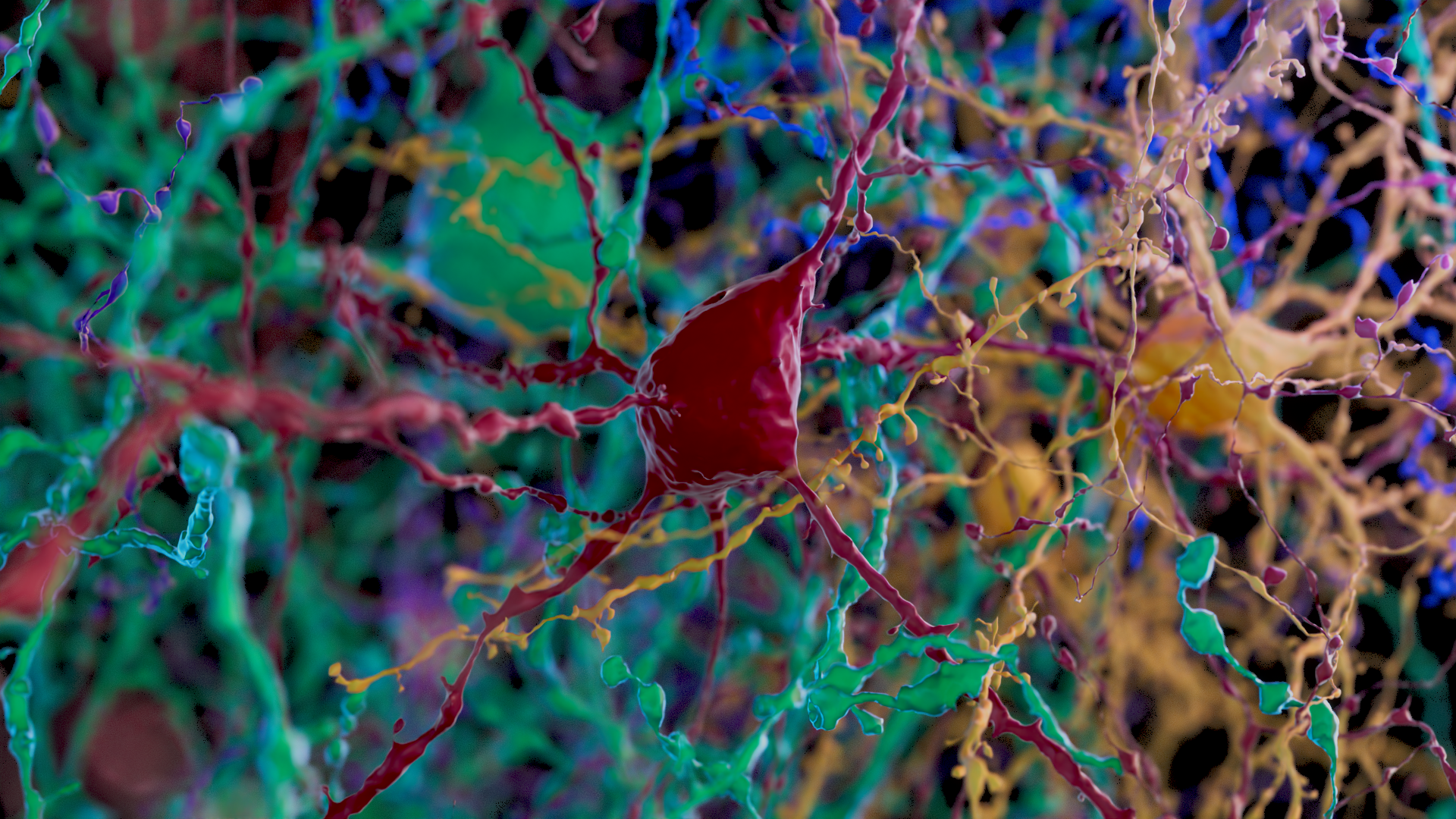
Render by Konstantinos Alexandrou, MRC LMB
The songbird basal ganglia connectome
Rother, A., Januszewski, M., Jain, V., Fee, M.S., Kornfeld, J. bioRxiv ↗ | October 2025
-
The basal ganglia (BG) play an essential role in shaping vertebrate behavior, ranging from motor learning to emotions, but comprehensive maps of their canonical synaptic architecture are missing. In mammals, three main neuronal pathways through the BG have been described - the direct, indirect, and hyperdirect pathways - which together orchestrate many aspects of learning and behavior. In songbirds, cell types associated with striatal and pallidal components appear intermingled in a single basal ganglia nucleus, Area X, essential for song learning. This allows for the dense reconstruction of the entire circuit within a compact volume. Here, we introduce the first vertebrate basal ganglia connectome, comprising over 8,500 automated neuron reconstructions connected by about 20 million synapses. High image quality and automated reconstruction allowed analysis with minimal manual proofreading. Based on direct anatomical measurement of synaptic connectivity, we confirm that a direct, indirect and hyperdirect pathway can be traced through Area X. However, detailed morphological and connectomic analysis revealed no clearly distinct direct and indirect medium spiny neuron subpopulations, and a dominance of the direct and hyperdirect pathway. In addition to previously identified neuron types in Area X, we could distinguish three novel GABAergic neuron types, two of which are major output targets of GPe neurons, leading to novel feedback circuitry within Area X. We further found unexpectedly strong neuronal interconnectivity and recurrency between neurons associated with all pathways. Our data thus challenge the universality of the view of the basal ganglia as an information processor organized into discrete feedforward pathways.
An anatomical substrate of credit assignment in reinforcement learning
Kornfeld, J., Wang, Y., Januszewski, M., Rother, A., Schubert, P., Goldman, M., Jain, V., Denk, W., Fee, M.S. bioRxiv ↗ | October 2025
-
A key problem in learning is credit assignment. Biological systems lack a plausible mechanism to implement the backpropagation approach, a method that underlies much of the dramatic progress in artificial intelligence. Here, we use automated connectomic analysis to show that the synaptic architecture of songbird basal ganglia (Area X) supports local credit assignment using a variant of a node perturbation algorithm proposed in a model of reinforcement learning. Using two volume electron microscopy (vEM) datasets, we find that key predictions of the model hold true: axons that encode exploratory variability terminate predominantly on dendritic shafts, while axons that encode song timing (context) terminate predominantly on spines. Based on the detailed EM data, we then built a biophysical model of reinforcement learning that suggests that the synaptic dichotomy between variability and context encoding axons facilitates efficient learning. In combination, these findings provide strong evidence for a general, biologically plausible credit assignment model in vertebrate basal ganglia learning.
Songbird connectome reveals tunnelling of migratory neurons in the adult striatum
Shvedov, N.R., Castonguay, S.J., Rother, A., Schick, D.E., Kornfeld, J., Scott, B.B. | Current Biology ↗ | May 2026
-
Immature neurons in the adult brain migrate and integrate into existing circuits, where they contribute to plasticity, learning, and complex behaviors. However, how these cells navigate synapse-rich regions of the adult brain remains poorly understood. While prior studies have examined the molecular mechanisms and functional consequences of adult neurogenesis, few have investigated the physical interactions between migrating neurons and their surrounding environment. Here, we use electron microscopy-based connectomics to examine how migrating neurons interact with mature circuit elements in the adult zebra finch striatum. Immature neurons exhibiting migratory features were observed contacting diverse structures in their microenvironment, including the axons, dendrites, synapses, and somas of mature neurons. Surprisingly, these interactions were structurally complex, often involving pronounced deformations of mature somas and the surrounding neuropil. These deformations appeared as “tunnels” made by the migratory neurons as they displaced mature structures along their path. Together, these findings suggest that migrating neurons may physically reshape the mature circuit to reach their targets, revealing an unexpected degree of structural and functional plasticity in the adult brain.